Noise Locator NL1

Noise Direction. Clear Decisions.

  • Determine direction of dominant noise
  • Easy to pinpoint the sound source
  • Compact and outdoor-ready design
  • One-cable XL3 integration
  • Reliability indicator (ΔPI) adds a level of confidence to the result


Know where noise comes from - with confidence.

The NL1 Noise Locator is a 3D outdoor sound intensity sensor that adds directional intelligence to noise monitoring systems.

Conveniently attached directly below the measurement microphone, and connected to an XL3 Sound Level Meter, it identifies the Direction Of Arrival (DOA) of the dominant noise source.

This compact sensor provides noise directivity in environmental monitoring where you are concerned with noise from a defined direction.

Why NL1

  • A compact solution
     
  • Especially effective for low-frequency analysis
     
  • Simple inline integration between XL3 and microphone
     
  • Designed for permanent outdoor operation
     
  • Synchronized logging of sound levels and direction
     
  • Pressure-Intensity Indicator (ΔPI) shows confidence level
     
  • Reports horizontal and vertical Direction Of Arrival
    (azimuth and elevation)

Locate the Predominant Source.

NL1 Action

WP40 microphone weather protection case, with bird spike, mounted on the NL1


Typical Use Cases

Shows where the noise is coming from in:

  • Environmental noise monitoring
  • Construction, road, aircraft and rail noise investigations
  • Industrial noise monitoring where there are multiple sources

How it Works

The NL1 uses eight microphones arranged in a compact 3D geometry. From these, 12 sound intensity probes are formed with a spacer of 2 cm, allowing A-weighted resolution in octave bands from 63 Hz to 4 kHz.

Sound intensity describes the direction of acoustic energy flow. By evaluating the resulting intensity vectors, the NL1 determines:

Azimuth (horizontal direction, referenced to North) and

Elevation (vertical angle, referenced to the horizontal)


NL1 Internal Microphones


Trustworthy Results

Real-world sound measurements are often affected by reflections and multiple sound sources. To help you judge the reliability of each result, every NL1 measurement includes a Pressure-Intensity Indicator (ΔPI).

ΔPI shows how trustworthy the sound direction result is. Lower values mean higher confidence, while higher values indicate that reflections or other sound sources may be influencing the measurement.

When the sound field is clean and well defined, ΔPI is close to zero and the result can be trusted. As reflections or additional sources increase, ΔPI rises, signalling reduced confidence.

Only measurements that meet the ΔPI criterion are used for directional analysis. This allows automatic filtering and defensible, reliable results in post-processing.
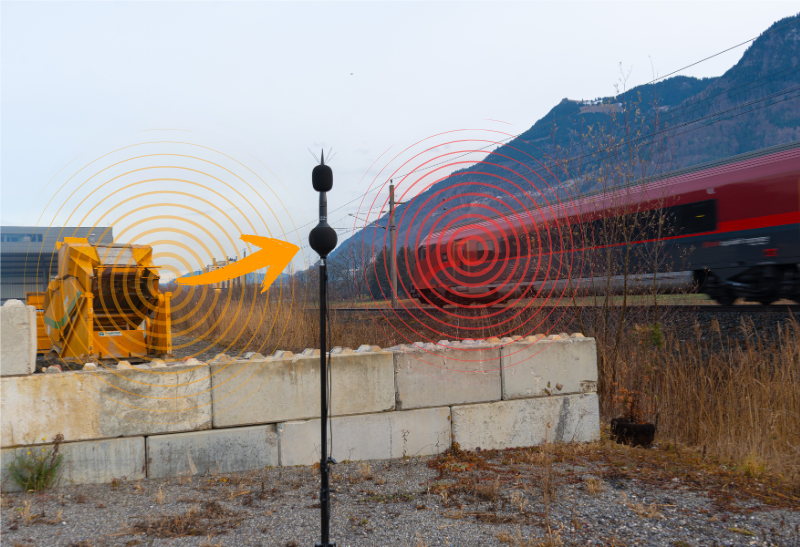
 

NL1 Action

Installation Guidance

For best results:

  • Avoid nearby reflective surfaces (recommended distance ≥ 5 m)
  • Install at sufficient height to reduce ground reflections
  • Position the sensor between relevant sources where possible

System Integration

The NL1 connects directly to the XL3 Sound Level Meter via a single USB cable:

  • Power and data over one cable
  • Direction data synchronized with noise data logging
  • Real time data available via the XL3 Streaming API

​


NL1 data is supported by NTi Audio software tools:

  • MeasurEye - segment-based accumulation of noise by source direction


  • Data Explorer - automatic marker generation based on directional segments

XL2 Data Explorer


  • NL1 Lab - experimental analysis tool demonstrating NL1 capabilities

Key Technical Data

  • Frequency range: 63 Hz – 4 kHz (octave bands) 
     
  • Time resolution: 100 ms or 1 s  
     
  • Dynamic range: 25 dBA – 125 dBA 
     
  • Power consumption: < 1 W (powered via USB) 
     
  • Based on sound intensity, rather than beamforming or pressure arrays 
     
  • Outdoor design, high wind and weather resistance 
     
  • The Pressure–Intensity Indicator (ΔPI) shows how reliable the sound direction result is by comparing sound pressure and sound intensity. A small value means the result is trustworthy, while a larger value indicates lower confidence.


Contact Us

For inquiries about NL1, support or availability.

Reach out anytime at info@nti-audio.com.
Prefer a local contact? Find your partner here: nti-audio.com/en/contact